Solving the General Problem: A Necessary Paradigm Shift for Fixing Healthcare
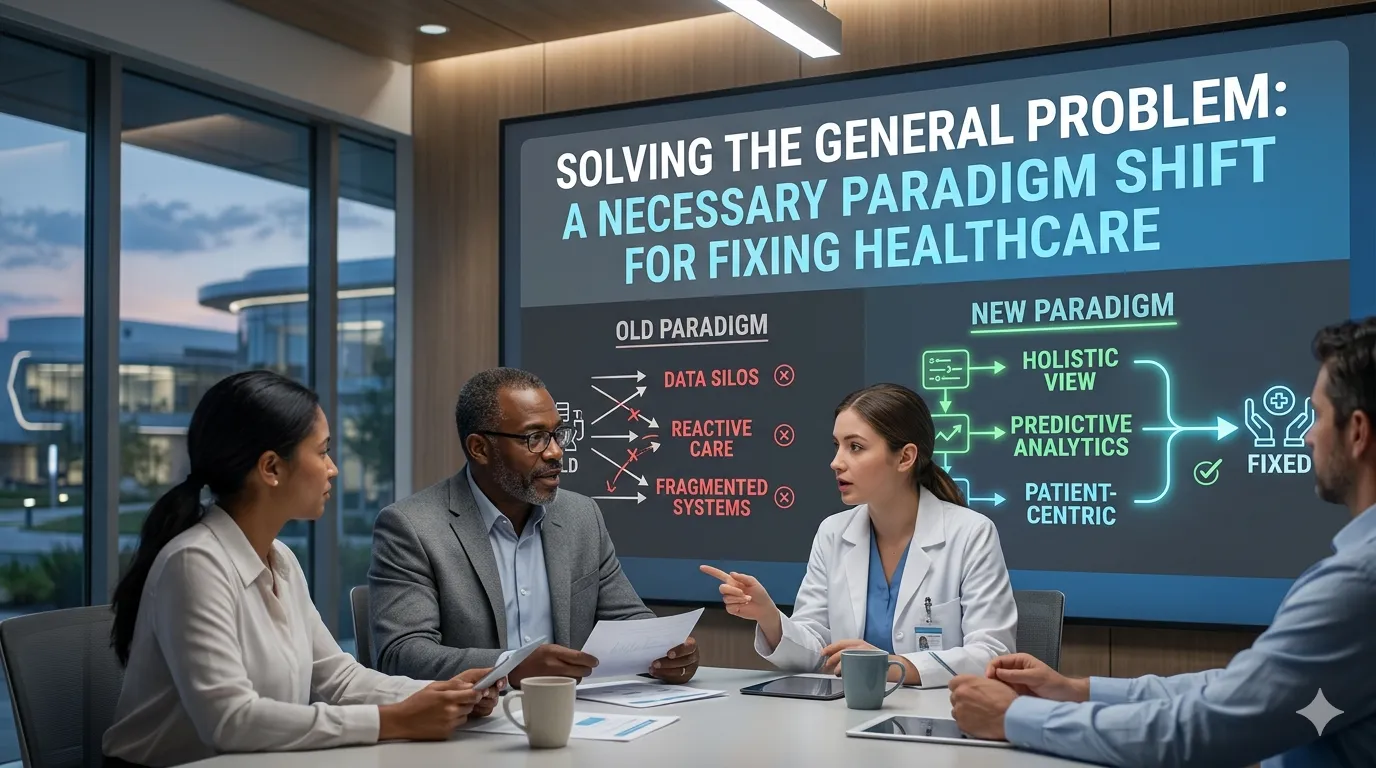
Integration and catering to specialties are killing medicine
Introduction
Today we are discussing ‘solving the general problem.’ We at Sentia have noticed that every industry and even departments in every industry all have little point solutions that help an employee or one department but never, ever, solve the general problem. If we have "Generally Accepted Accounting Principles” (GAAP) why do we need hundreds of thousands or millions of little point solutions that all do the same things in their categories?
The Situation
Every company over a certain size is told by some huge consulting firm to install ServiceNow, Salesforce, Workday, SAP or any of a million solutions. Every company under that size runs on spreadsheets and is just about as efficacious. The problem with both is that nobody knows what anyone else is doing and there is no accounting for any of it.
Communication
Since all the data is siloed into point solutions, nobody has insight into more than one department. Everyone is duplicating effort and wasting time retyping the same data and doing the same processes over and over. Accounting and HR have no idea what employees do day to day. Leadership can pull a report out of the Enterprise Resource Planning (ERP) system, but that report doesn't tell them what the bottlenecks are. Nobody has any idea how productive any particular employee is doing without micromanaging them.
Bad Design
Most of the point solutions are so badly written that they have to be modified to fit your particular situation. That requires you as a business owner to hire developers and architects to finish the Computer Off The Shelf (COTS) software you just spent millions on, to do what you need to have done. That means you need to have the development resources, the networking, the server infrastructure, helpdesk and support, equipment and maintenance, and all the things you need to develop your own software. Why did you buy a COTS solution if you have to rewrite and update it for your situation?
Integration
Even after you redevelop and fix the mistakes from your vendor, you really haven’t accomplished anything for the millions you have spent. There is no return on investment. Instead of training for your particular instance of Salesforce, Workday or ServiceNow, you could have saved millions and just emailed the spreadsheet like mom and pop and had the same results for millions less.
The point here is that you have to integrate these systems together. To make these systems worthwhile, you have to make them share data. That means you have to get permission from the vendor to access their database, which is not going to happen, or you have to use their Application Programming Interface (API) to get and set data in that database. If you use the API and you will, you are at the vendor’s mercy as to what you can get and set. If you are setting data inside their database, what do you need them for anyway?
Healthcare Example
Your practice or hospital has some kind of Practice Management (PM) system. Your practice or hospital has some kind of Electronic Medical Records (EMR) system. You have a Billing, Coding and Collections Department. None of these entities knows anything about what the others are doing. There is no communication. Your EMR is basically just a text machine that saves whatever notes the docs type in. The billing department goes in and assigns codes to the text saved in the EMR, manually, as in by hand. In 2026 why in the world are we manually looking up codes for typed in text? The PM system is basically just an accounting package that tracks who paid what, but for medicine. The EMR is fragmented by specialty and the specialties don’t talk to each other.
The Logical Conclusion
Everyone is bumbling around either spending millions on point solutions or emailing spreadsheets, both with manual interventions, and getting nothing in return. All the money spent on HR solutions, ERP systems, and all the little point solutions plus redesigning and rebuilding and all the infrastructure, is wasted.
The big consulting firms found out about a decade ago that they weren’t smart enough to build software so they pivoted to the point solutions. These ‘solutions’ are worthless. Once you pay for the solutions, pay to have them finished and pay to integrate them you could have designed and built your own solution for less and it would be more robust since it would not have shaky integrations.
The result is that tens of thousands of businesses simply won’t make it due to either emailing spreadsheets or spending millions and getting nothing. The businesses that don’t fail are in industries that have larger margins and can sustain the cost. It isn’t that they are getting anything for the money, it is that they have larger margins. Your software should be a profit center, not a cost center. You should automate tasks and then be able to report on that automation so you know exactly how much you saved. That increases your bottom line.
Let’s extend the healthcare example. A larger hospital, with more than 250 beds and 750 practitioners, has dozens of specialties (or 40-50 for large teaching hospitals) each with their own specialty EMR. Even if they are using Epic or Cerner, each of the specialties has its own deployment and those deployments are all custom built for the individual client.
Here lies madness.
That means that each department uses its own, one off, hand coded solution. That means that the programmers that built it are either on the hook for that client for life, or that you are getting support from someone that has no idea what nor how it was done if anything ever goes wrong.
Something always goes wrong.
You just spent tens or hundreds of millions of dollars on your new EMR, then you have to pay to have it modified for your particular situation, then you can’t get support for it. Support that you pay another 20% per year for. In some cases that support contract is worth hundreds of million per year. After all that, you have to pay your Billing, Coding and Collections Department to manually look at the text that practitioners type in, translate it to codes that the payers (insurance companies) understand and then wait 90 to 180 days for payment.
This kind of inefficiency is killing smaller hospitals. If nothing changes, in the future there will be millions of Americans who have no place to get healthcare after their local general hospital shuts down. People will die. Communities will spiral down an unhealthy path with no guidance and no acute care.
Healthcare cost will continue skyrocketing out of control.
People will die.
The Short Answer
There are three options:
- Keep emailing spreadsheets
- Go back to emailing spreadsheets, it is cheaper and just as efficient
- Write your own software. You are anyway, so why not?
The Slightly Longer Answer
Solve the general problem. Here is what happens. Employee A comes to Developer B and asks for a function that adds 3 to 5. Developer B writes a function that returns 8 no addition required:
public int Add3To5()
{
return 8;
}
Easy, fast and exactly fits the requirements. A point solution. What Employee A really wanted was a way to add a column of numbers, even if s/he didn’t know it. A better way to solve the generic problem would be to take an array or a list of numbers and loop through to add them and return the result.
Instead of writing bazillions of point solutions, write one that does what you need it to do, in a generic way, that can be tailored via configuration to do what needs to be done. That is what we do at Sentia. Going back to the healthcare example one more time, we have written a universal EMR.
Gee, that’s great. How does that help with billing, coding and collections, or practice management or integrations or any of the thousand other things that need to be done in the hospital, or enterprise?
Sentia has produced an Electronic Medical Records System (EMR) that is data-driven. It is based on the Unified Medical Language System (UMLS), an universal nomenclature that is adequate to document any patient encounter. It is the only one of its kind. We won’t go into all the benefits here, if you’ve been following along you know already, but we will hit the highlights of how this data-driven EMR is different and how with it, you can automate the entirety of the health insurance industry and most of hospital and practice administration.
Benefits of a data-driven EMR
Nobody Reads your “Notes”
First, doctor, nobody reads your notes. I know you are succinct and eloquent and you know that nobody reads them. Having data will make your documentation searchable and only return relevant results instead of having to read reams of wandering, meandering prose that has little to nothing to do with the case, or that have been copied and pasted and contain wholly irrelevant information. This is science. Treat it as science. We don’t need succinct and eloquent we need data.
Searching
With a data-driven EMR, you can do searches for the thing you are looking for. Since the complaint is related to the symptoms are related to the lab results are related to the clinical observations are related to the diagnoses, are related to the treatments, are related to the outcomes, you could literally enter the complaint and come up with a list of differential diagnoses and successful treatments. You could search anywhere in that chain and enter new data. The eight season, 177 episode, House television series would turn into “I entered the symptoms into the EMR and it gave me five differential diagnoses and I chose the correct one. Goodnight folks!”
Aggregating
With a data-driven EMR you can produce population health reports detailing problems and allowing us to come up with overall solutions for any population no matter the size. We can also produce individual health reports because the care is not hidden in typed notes.
Integrated Health Coverage
Since Sentia built the world’s only data-driven EMR, we are the only ones who can integrate health coverage right into the EMR. With reference based pricing, we suggest 150% of Medicare, we can pay for procedures performed in real time. Document care, get paid. No claims, no adjudication, no delays, no denials, no monkey motion. Get paid in real time.
This is real coverage with all the inherent actuarial math, just without all the administrative burden of medical coding, verification, adjudication, pre-authorization, denials, delays, insurance networks, rate negotiations and sales/brokers/agents. That alone saves the patient about half from their premium.
Practice/Hospital Management System (PHMS)
Because we have a data-driven EMR, we can run a profit and loss )P&L) statement for any employee/doctor, room, procedure, piece of equipment, consumable, wing, floor or the entire enterprise for any time period, with the click of a button. That makes it exceedingly easy to find and fix cash leaks and streamline and automate the entire medical enterprise.
Exorcise ‘workflow’ thinking. Instead of assigning workers to work, assign the work to the workers. Normally, we have one nurse to four rooms. That results in half the staff standing around gossiping, while the other half is in the weeds, trying to do four things at once, and letting care fall through the cracks. Workflow thinking kills patients. Instead, queue the work according to age and urgency, and assign the oldest/more urgent task to the longest idle worker. That way all the work gets distributed equally and a long running task can get the attention it deserves instead of put off and put off until it gets completely forgotten.
The combination of the integrated health coverage and the PHMS should save the enterprise about a quarter.
Health and Wellness
Because we have a data-driven EMR we can automatically prescribe patient education based on the patients procedures and lab results. We have partnered with WebMD Ignite to provide this documentation. Not only do we provide the education for the patient but the education includes a ‘temp gauge’ showing the patient graphically how immediate the problem is, plus instructions on how to fix the problem.
To give the education teeth, we offer a 1% discount for simply opening the education long enough to read it. Then when the education is followed and the lab results come back in line with normal values, we offer an additional 14%, that is 15% total, discount for staying healthy and saving us all money.
Almost 90% of healthcare spending in the US is on behavior-based, avoidable chronic disease. Simply getting us down to the OECD average mortality for behavior-based, avoidable chronic disease would save the US about a trillion and half dollars from the cost of healthcare.
Conclusion
This is what we mean when we say “solve the general problem.” Account for the edge cases. Automate anything that is automatable. My team was tasked with building a scheduling system years ago. The system we were replacing was hard coded to the location it was written for. They had four operating rooms and ten procedures and nine drugs and that is all they could ever have. Instead of just rewriting the system for the new building, we designed and built a scheduling system that was capable of booking Whitesnake in Reunion Arena, with all the associated jobs, equipment and concert goers. We had to account for the band, its equipment, the stage to put it all on, security, ushers, custodial people and supplies, ticket takers, box office, the places for ticket takers and box office, seats and concert goers, and we had to do it in a data-driven way so that we could configure the whole event without rewriting any code. Once we did that, putting a doctor, a CRNA, a patient and a colonoscope in a room at the same time was trivial.
With the data-driven EMR we can completely fix healthcare finance. We demonstrated a way to save the patient half, the hospital or practice an additional 25%, and the population of the US about 75% from the cost of healthcare. We do this with streamlining, automation and really thinking about solving the general problem and not just the easiest way possible.
This is solving the general problem.
We have shown a way to regulate every financial transaction a practice or a hospital enters into, the Practice/Hospital Management System (PHMS). Included with the PHM is a workflow elimination tool that extracts more and better work from employees and streamlines and automates every facet of patient care. All that increases revenue and decreases costs.
We have shown a way to incentivize healthy living in a population and decrease chronic disease and therefore decrease costs for us all in a streamlined and automated manner. This alone has the potential to save $1.49 trillion or about 25% of healthcare spending in the US
We have shown a way to revolutionize the way medical records are thought of, executed, used and searched. This eliminates Epic and all the legacy EMR vendors and makes research a simple pick and click operation, saving millions of lives.
We have shown a way to integrate health coverage into the EMR. The practice or hospital gets paid as the practitioner documents patient care. That eliminates medical coding, verification, adjudication, pre-authorization, denials, delays, insurance networks, rate negotiations, sales/brokers/agents, money for a third-party EMR, skyscrapers in every major city, hundreds of thousands of employees, all the insurance monkey business and reduces cost by about half.
It also eliminates Epic/Cerner AND all the legacy insurers.
It also makes your facility leaner, faster, more efficient and more profitable.
This system includes the automation of the health insurance industry completely, eliminating more than half the costs by Sentia as the coverage company, employer based captive or TPA, or by facilitating direct payments to doctors and practices.
Here are additional points detailing the costs incurred by the legacy insurance companies that you pay currently, in addition to wasting about half your premium, according to Grand View Research and current as of 2023 and that Sentia would eliminate completely:
Medical Records:
- The average practitioner spends $35,925 annually on electronic medical records
- The average patient spends $106 annually on electronic medical records
- The average patient encounter or visit cost for electronic medical records alone is $32
Medical Coding:
- The average practitioner spends $20,286 annually on medical coding
- The average patient spends $60 annually on medical coding
- The average patient encounter or visit cost for medical coding alone is $18
Compliance and Efficacy Reporting:
- The average practitioner spends $17,165 annually on compliance and efficacy reporting
- The average patient spends $51 annually on compliance and efficacy reporting
- The average patient encounter or visit cost for compliance and efficacy reporting alone is $15
Totals:
- The average practitioner spends $73,376 annually on completely avoidable costs
- The average patient spends $217 annually on completely avoidable costs
- The average patient encounter or visit cost for completely avoidable costs alone is $66
Yes, you read that correctly: $66 per visit. That is more than the practice makes on the average encounter. There must be a better way.
There is a better way and Sentia has it.
Remember also that these costs are over and above the 50%+ your insurance company wastes or shoves into their pockets.
Implementing this system should be fairly simple and will completely revolutionize the way healthcare is delivered and paid for, saving countless lives. We have shown a way to use this system to make the best healthcare system in the world also the most efficacious and the most affordable.
If you liked what you read contact us here, on our site, SentiaHealth.com, our parent company SentiaSystems.com, or send us an email to info@sentiasystems.com or info@sentiahealth.com.
Comment
| Date Written | Comment |
|---|