You’re Doing It Wrong Part 12: The Technology Skills Gap and the IT Talent Shortage
Or: How Executive Illiteracy Cost You Your Best Engineers
Introduction
We are taking a brief hiatus from healthcare and health insurance to launch a broader strategic series: You’re Doing It Wrong. In this 15-part series, we expose the counterproductive tactics corporate leaders use—tactics that inflate the cost of their products and services, ultimately passing the bill to you, the consumer. In this twelfth installment, we examine the fundamental lack of operational thinking behind executive complaints regarding the "IT talent shortage."
Why take a break from healthcare? Simple: structural dynamics haven't changed. AI hype continues to substitute for basic software architecture, EMR vendors still attempt to document clinical encounters through narrative text rather than discrete data structures, and insurance overhead continues to extract value without adding it. If you need your weekly dose of health tech analysis, read our article Data is the future of medicine, not text and typing, and not with thousands of drop-down menus.
The Situation
few weeks ago, I reviewed an article titled the 22 Biggest Business Challenges Holding Companies Back in 2025. Most listed items—inflation, supply chain friction, trade volatility—were external macroeconomic variables outside direct management control. However, several internal items highlighted an alarming operational pattern:
- Employee Retention and Engagement Issues
- Remote and Hybrid Work Complications
- Digital Transformation Pressure and Implementation
- AI Integration and Deployment Challenges
- Legacy System Integration and Modernization
These listed "challenges" are not external market forces; they are internal execution failures. Corporate leadership consistently misdiagnoses fundamental operational neglect as macroeconomic strategy problems.
The Logical Conclusion
These management headaches are self-inflicted wounds, stemming from executive teams that lack a granular understanding of what their organization produces or how its operational processes function.
Employee Retention and Engagement
Retention failures are rarely about culture decks or engagement initiatives—they are about operational friction. Top talent leaves when executive mandates force them to execute low-value directives that directly undermine productivity, paired with compensation packages that lag behind market benchmarks.
Remote and Hybrid Work Complications
We addressed this two weeks ago in this series. Mandating physical office presence to monitor output is an admission of managerial incompetence. If your metrics require physical oversight to gauge productivity, you lack meaningful performance data. Sunk commercial real estate leases should be written off as bad capital allocation, not subsidized by forcing knowledge workers to absorb commuting friction.
Digital Transformation
Outside corporate buzzwords, "digital transformation" lacks operational definition. An organization either executes work through optimal, lean processes, or it does not.
AI Integration and Deployment Challenges
Deploying generative models without explicit architecture targets is financial waste. Large Language Models operate on statistical token prediction—they generate probabilistic text sequences based on patterns in training data. They do not reason, evaluate context, or audit outputs for correctness. Investing heavily in predictive text generation to automate complex operational decision-making misunderstands the core tenets of the technology.
Legacy System Modernization and Integration
Before launching an expensive modernization campaign, audit the actual utility of your legacy systems. Evaluate every integration point and business output. In most enterprise environments, you will find that frontline staff have spent years engineering workarounds to bypass defective software that leadership assumes is critical infrastructure.
Leadership is steering enterprises into operational gridlock through a failure to comprehend basic execution, operational process dependencies, and outcome measurement.
Those are the problems and the logical conclusion we promised is this: “leadership” is running companies into the ground with their lack of understanding of what the company does, how it does it and how to manage the outcomes desired.
The Short Answer
Halt current broad-scale modernization initiatives immediately and conduct a forensic audit of how your operational workforce spends its hours. The items above are not external market challenges; they are operational land mines laid by leadership insulated from frontline realities.
You have stacked layers of management between executive decision-makers—who approve enterprise software contracts based on golf course sales pitches—and the core builders actually producing value. Direct your management tier to audit and log every discrete task performed by frontline workers over a multi-week period.
The results will be uncomfortable: a massive percentage of operational capacity is burned on non-productive overhead—interminable alignment meetings, redundant approval ceremonies, and manual workarounds for poorly configured software tools.
Systematically eliminate these obstacles. Assign single-point accountability to individual managers to fix specific workflow bottlenecks, and hold them strictly to measurable execution outcomes.
Once those bottlenecks are cleared, eliminate the redundant management bloat and the arbitrary return-to-office mandates designed solely to justify their supervision.
The Slightly Longer Answer
Disconnect from vendor sales pipelines designed to sell software licenses rather than solve operational bottlenecks and stop adopting executive buzzwords you read in C-Suite Insider. Let’s return to our core thesis and address the structural solutions:
Employee Retention
High-performing employees do not want to leave solid organizations, nor are competitors routinely poaching them out of nowhere. Personnel resign when leadership forces them to navigate low-value administrative friction, provides sub-market compensation, and insulates executive leadership from frontline operational reality through layers of middle management. The personnel executing daily tasks often possess clearer insights into operational inefficiencies than external advisory teams.
Consider Lexus Chief Engineer Ichiro Suzuki during the development of the LS400. While his developmental process flirted with extreme financial risk, his underlying discipline was sound: master the micro-details of execution before scaling. Excellence requires understanding how the product is actually built at the fundamental level.
Remote Work
The debate is over: knowledge work outcomes are not tied to physical real estate footprints. Unless a role requires physical manipulation of tangible hardware or physical inventory, location is irrelevant to total output. Long-term commercial real estate leases represent historical capital allocation errors; forcing physical occupancy does not recoup those sunk costs. Eliminate mandatory in-office mandates and status-checking meetings. Prioritize verifiable output over physical presence.
Digital Transformation
Purchasing third-party platform licenses is not an enterprise strategy. Relying on off-the-shelf SaaS behemoths (Salesforce, SAP, Workday) forces your operational workflows to conform to external software constraints rather than your unique competitive advantages. Licensing massive enterprise suites without dedicated internal engineering leads to multi-million-dollar implementation cycles that inflate administrative overhead while solving zero core delivery problems.
Examine your administrative cost centers. If internal departments exist primarily to enforce compliance rather than drive core delivery, you have introduced an internal tax on your revenue generators. Instead of spending millions attempting to integrate third-party platforms designed for generic corporate use cases, invest in competent internal engineering teams to build tools tailored directly to your operational processes.
AI Integration and Deployment
Deploying generative models without explicit architecture targets is pure financial waste. Large Language Models operate on statistical token prediction—they generate probabilistic text sequences based on patterns in training data. They do not reason, evaluate business context, or audit outputs for structural correctness. Investing heavily in predictive text generation to automate complex operational decision-making fundamentally misunderstands the physics of the technology.
Furthermore, LLMs are alignment-tuned to generate agreeable outputs—they mirror user assumptions rather than providing rigorous validation. Relying on conversational interfaces for critical strategy is a poor substitute for domain discipline.
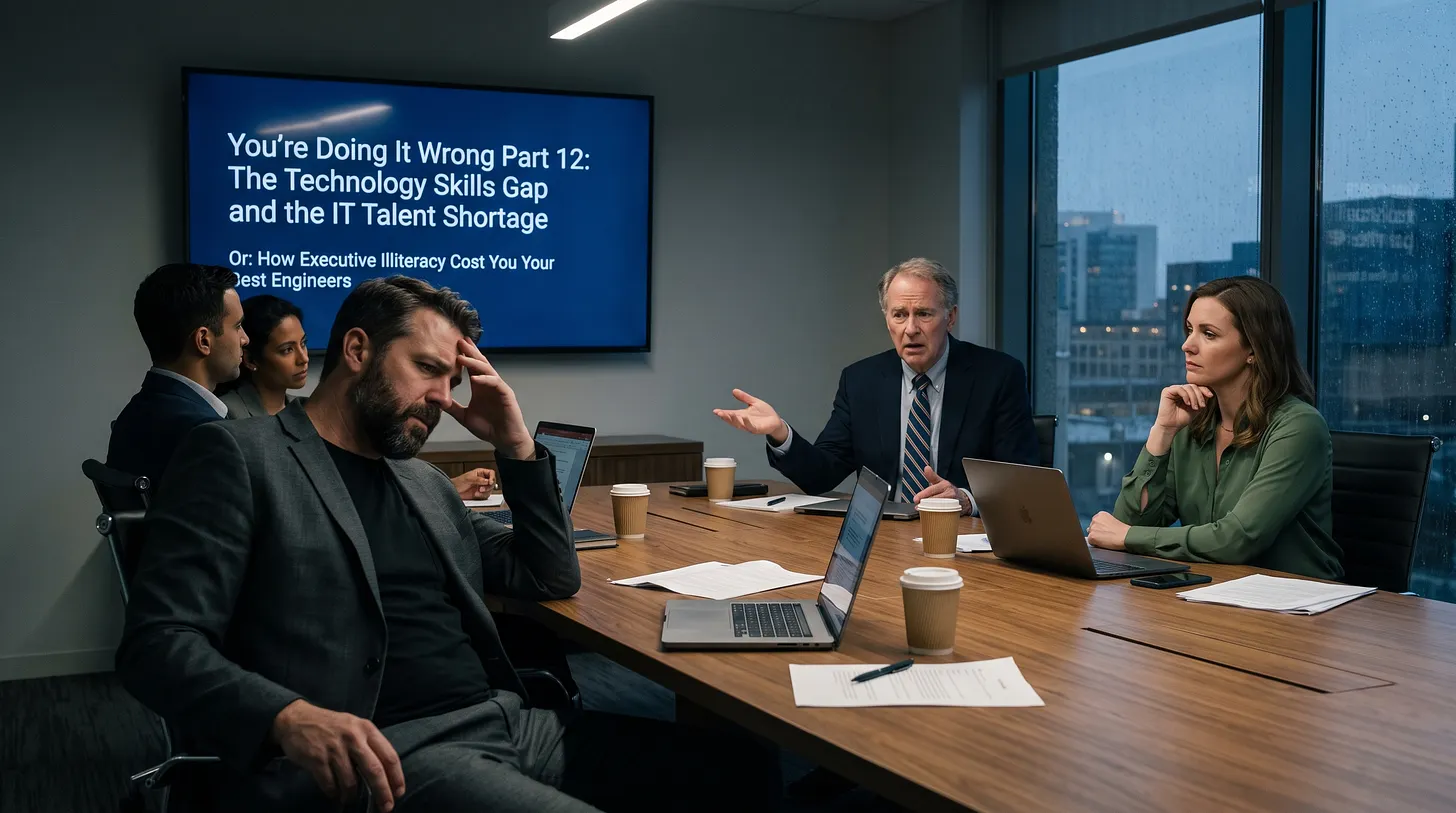
The Technology Skills Gap and the IT Talent Shortage
The enterprise "talent shortage" is an organizational positioning failure. Highly skilled engineers routinely reject environments where technical talent is reduced to wiring API connectors between mismatched vendor platforms for managers who don't understand the tech stack. Elite builders select organizations where engineering creates real leverage, not where legacy technical debt and bureaucratic oversight consume 80% of development capacity.
And no, offshoring is not the solution. Execution without operational clarity simply accelerates bad outcomes at lower hourly rates. External vendor teams will execute ambiguous or flawed executive directives without pushback, resulting in high rework cycles, security vulnerabilities, and technical debt that ultimately cost multiples of a domestic engineering investment.
Conclusions
Corporate leaders are their own worst enemies. Fulfilling your obligation to clients and employees requires delivering maximum value at optimal cost, which is an objective most enterprise leadership structures fail to achieve.
Outsourcing strategic diagnosis to tier-one consulting firms yields standardized slide decks rather than operational turnarounds. These advisory firms operate as high-priced mail merges. They bill millions to populate executive templates with your company name, granting C-suite leaders artificial cover for bad decision-making.
Executive leadership must understand how their organization produces value at the physical execution level. Management in the abstract is not a standalone skill set. Business is not a vague concept; companies produce concrete goods and services. Financial engineering is not value creation, and manipulating balance sheets does not improve product quality or operational delivery. When financial manipulation replaces operational discipline, economic instability is the guaranteed result.
Economic recessions are caused by business leaders repeating execution mistakes every decade and conflating operational incompetence for economic cycles. There are no economic cycles, just operational incompetence. Avoid becoming an executive statistic. Spend the time to audit your operations, understand your technical stack, and streamline production before market forces dictate your outcome for you.
I hope this critique provides the urgency required to drive real operational change. Feel free to share your thoughts in the comments below, or reach out directly.
This is part twelve of a fifteen-part series analyzing corporate management failures and practical operational solutions. We publish new analysis weekly. Share your experiences in the comments below, or contact us directly via SentiaHealth.com, our parent company SentiaSystems.com, or via email at info@sentiasystems.com or info@sentiahealth.com.
I will be putting out one or maybe two articles per week. If you liked what you read or want to relate your personal experiences, contact us here, on our site, SentiaHealth.com, our parent company SentiaSystems.com, or send us an email to info@sentiasystems.com or info@sentiahealth.com. By here I mean drop a comment below; feel free to tell me I’m a cotton-headed ninny-muggins, or reach out directly.
Comment
| Date Written | Comment |
|---|